

By Dr Sumit Toor
Introduction
Cosmetic surgery has seen a significant rise in popularity across India, offering individuals the opportunity to enhance their appearance and boost their self-confidence. However, the journey to a successful outcome begins long before the first incision. As a board-certified plastic surgeon, I have found that the most critical factor in patient satisfaction is not just the surgical technique, but the alignment of expectations with reality.
The Importance of Realistic Expectations in Aesthetic Surgery
In the realm of aesthetic surgery, success is subjective. While a surgeon may achieve a technically perfect result, a patient may still feel dissatisfied if their initial expectations were not grounded in reality. Realistic expectations serve as the foundation for a positive surgical experience, ensuring that the patient understands the scope, limitations, and potential risks of the procedure.
The Relationship Between Expectations and Patient Satisfaction
Patient satisfaction is the ultimate goal of any cosmetic procedure. When a patient enters surgery with a clear understanding of what can be achieved, they are more likely to appreciate the improvements made. Conversely, unrealistic goals often lead to disappointment, regardless of the surgical skill involved. This is why the pre-operative phase is dedicated heavily to education and alignment.
Why Consultation and Education Matter
A thorough consultation is more than just a medical check-up; it is an educational session. It allows the surgeon to evaluate the patient’s anatomy and for the patient to voice their desires. This dialogue ensures that both parties are on the same page regarding the achievable aesthetic goals, the recovery process, and the long-term maintenance required.
Common Unrealistic Expectations Patients May Have
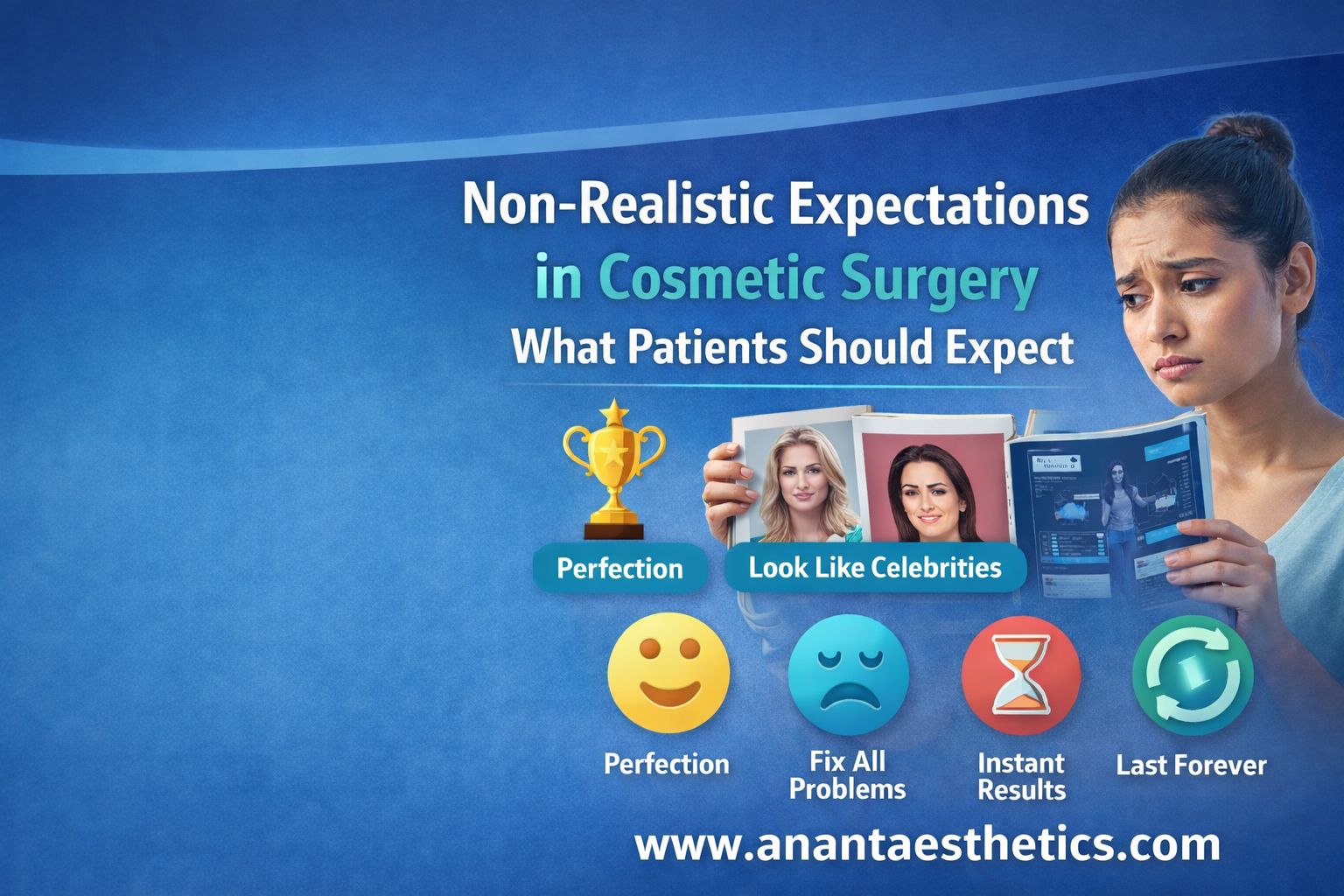
In the age of social media and digital filters, it is easy for patients to lose sight of biological reality. Here are some of the most common misconceptions encountered in clinical practice:
- Expecting Perfection and Absolute Symmetry: The human body is naturally asymmetrical. While surgery can improve balance, achieving 100% mathematical symmetry is biologically impossible.
- Wanting to Look Exactly Like Celebrities: Many patients bring photos of influencers or Bollywood stars. While these can serve as a reference for “vibes,” every individual has a unique bone structure and skin type that dictates their specific results.
- Solving Life Problems: Cosmetic surgery can enhance your appearance and self-esteem, but it cannot fix personal relationships, career challenges, or deep-seated psychological issues.
- Expecting Instant Results: Healing takes time. Swelling and bruising can mask the final outcome for weeks or even months.
- Assuming Results Last Forever: While surgery can “turn back the clock,” it does not stop the clock. Natural aging, lifestyle choices, and gravity will continue to affect the body over time.
Why Cosmetic Surgery Has Limitations
It is important to understand that a surgeon works with living tissue, not clay. Several factors limit what can be achieved:
- Individual Anatomy: Your underlying bone structure and muscle placement provide the framework for any enhancement.
- Skin Quality: Factors like elasticity, thickness, and previous scarring significantly influence how the skin drapes and heals after surgery.
- Healing Variability: Every patient heals differently. Genetics, nutrition, and lifestyle habits (like smoking) play a massive role in the final appearance of scars and tissue recovery.
What Patients Should Realistically Expect
A successful cosmetic procedure should be viewed as an improvement rather than a transformation into a different person. Patients should prepare for the following:
- Natural-Looking Enhancement: The goal is often to look like a refreshed, better version of yourself.
- Presence of Scars: Any surgical incision results in a scar. While surgeons use advanced techniques to hide them in natural creases, they are a permanent part of the process.
- Gradual Healing: Final results for procedures like rhinoplasty or liposuction may not be fully visible for 6 to 12 months.
- Possibility of Revisions: In some cases, minor touch-ups may be necessary to achieve the best possible outcome, as tissue can shift during the healing phase.
Psychological Considerations
Mental health is just as important as physical health in aesthetic surgery. Surgeons often screen for Body Dysmorphic Disorder (BDD), a condition where a person becomes obsessed with perceived flaws that are minor or invisible to others. Emotional preparedness and a stable state of mind are essential for anyone considering elective surgery.
How Surgeons Help Set Expectations
Professional surgeons use several tools to help patients visualize their journey:
- Detailed Consultations: Discussing the “why” and “how” of the procedure.
- Before-and-After Galleries: Viewing results from previous patients with similar body types to understand realistic outcomes.
- Risk/Benefit Counseling: An honest discussion about potential complications.
In some instances, a surgeon may decline to perform a procedure if they feel the patient’s expectations cannot be met or if the risks outweigh the benefits. This is a mark of ethical medical practice.
Frequently Asked Questions (FAQs)
Can cosmetic surgery make me perfect?
No. Surgery aims for significant improvement and enhancement, but perfection is an unattainable standard in biological systems.
Can I look exactly like someone else?
No. Your results are limited by your own unique anatomy. Surgery can emulate certain features, but you will always look like a version of yourself.
How long before final results appear?
While initial recovery takes 1-2 weeks, final results typically settle between 3 to 12 months depending on the procedure.
Why might revision surgery be needed?
Revisions may be needed due to unpredictable healing, scar contraction, or to fine-tune a result once the initial swelling has completely subsided.
Conclusion
The most rewarding cosmetic surgery outcomes occur when a patient’s realistic expectations align perfectly with expert surgical planning. By understanding the limitations of the human body and focusing on enhancement rather than perfection, you can achieve a result that brings lasting confidence and satisfaction.
Anant Aesthetic Clinic, Adampur