

By Dr Sumit Toor
Introduction to LASER Technology in Plastic Surgery
In the evolving landscape of aesthetic medicine, laser in plastic surgery has transitioned from a futuristic concept to an essential tool in a board-certified surgeon’s armamentarium. For our patients in India, understanding these technologies is crucial, as our unique skin types require a nuanced approach to ensure safety and efficacy. LASER technology allows for unprecedented precision, enabling us to treat skin concerns with minimal downtime and enhanced results compared to traditional methods.
What Does LASER Stand For?
The term LASER is an acronym for Light Amplification by Stimulated Emission of Radiation. Unlike natural light, which spreads out and contains many different wavelengths (colors), laser light is monochromatic (one specific wavelength), coherent (waves are in phase), and collimated (travels in a narrow, parallel beam). This allows the energy to be focused on a very specific target in the skin.
Basic Physics of LASER Explained
To appreciate how laser skin treatment works, one must understand three fundamental concepts of physics that guide every procedure we perform.
Wavelength
The wavelength determines the color of the laser light and, more importantly, what it targets in the skin. Different wavelengths are absorbed by different “chromophores” (targets) such as water, melanin (pigment), or hemoglobin (blood).
Selective Photothermolysis
This is the cornerstone of modern laser surgery. It refers to the ability to precisely target a specific tissue (like a hair follicle or a brown spot) and destroy it using heat, without damaging the surrounding healthy skin. This is achieved by choosing the right wavelength and pulse duration.
Tissue Interaction
When laser light hits the skin, it can be reflected, scattered, transmitted, or absorbed. In plastic surgery laser applications, we aim for controlled absorption, where the light energy converts to thermal energy to achieve the desired surgical or aesthetic effect.
Types of LASERs Used in Plastic Surgery
There are several types of laser in cosmetic surgery, each suited for specific skin concerns and skin tones.
- CO2 LASER: A powerful ablative laser used for deep laser resurfacing and surgical cutting. It targets water in the skin cells.
- Er:YAG LASER: Similar to CO2 but more gently absorbed by water, making it ideal for superficial resurfacing with faster healing times.
- Nd:YAG LASER: With a longer wavelength, this laser penetrates deeper and is significantly safer for darker Indian skin types (Fitzpatrick IV-VI) as it bypasses surface melanin.
- Diode LASER: Primarily used for highly effective and long-term hair reduction.
- Alexandrite LASER: Excellent for treating pigmentation and hair removal in lighter skin tones.
- Pulsed Dye LASER (PDL): The gold standard for vascular lesions, targeting the red pigment in blood vessels.
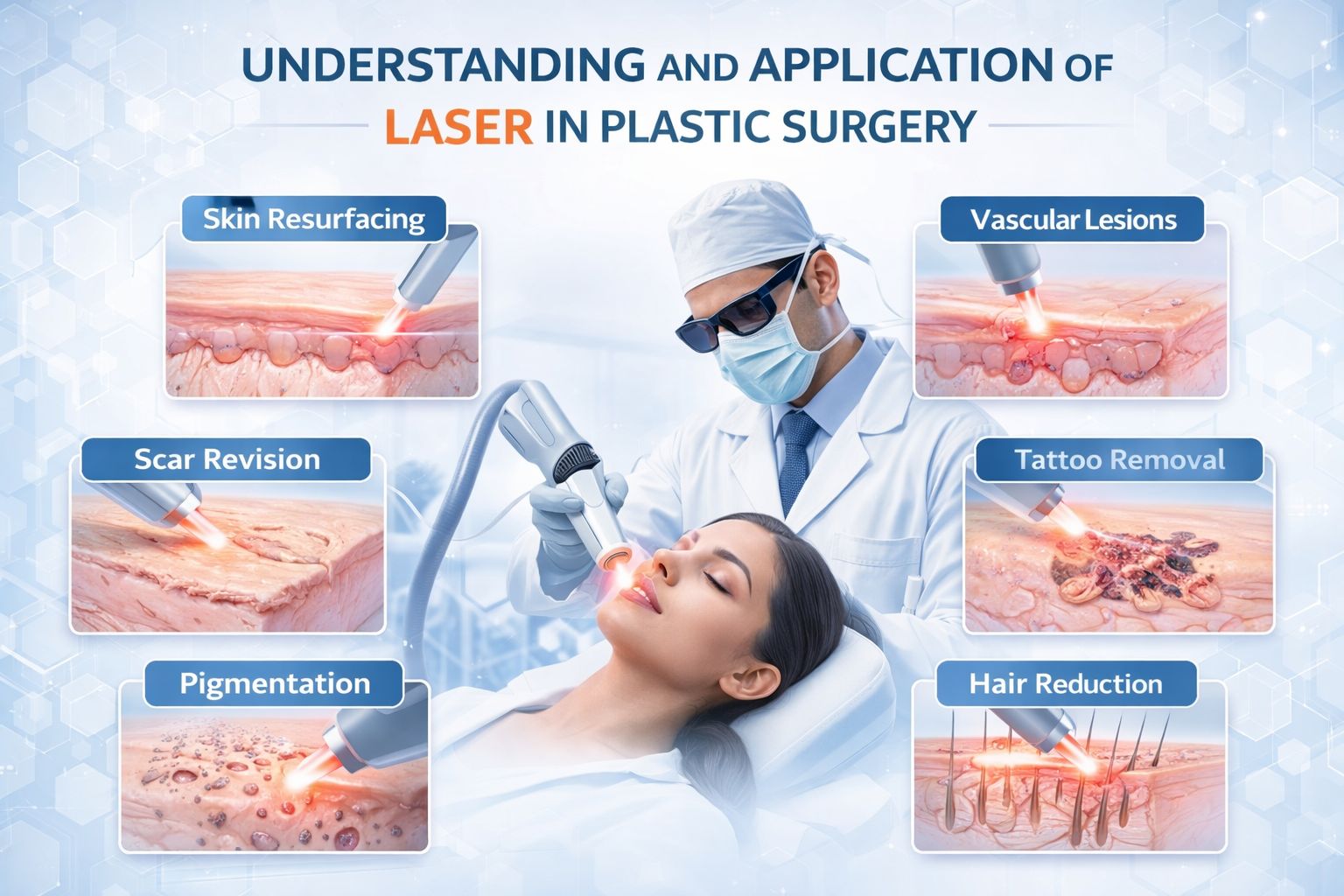
Common Applications of LASER in Plastic Surgery
The versatility of laser technology allows us to address a wide array of aesthetic and functional concerns:
- Skin Resurfacing: Reducing fine lines, wrinkles, and improving overall skin texture.
- Scar Revision: Softening the appearance of surgical scars, acne scars, and keloids.
- Pigmentation Treatment: Clearing sunspots, melasma, and age spots, which are common concerns for Indian patients.
- Hair Reduction: Providing a permanent reduction in unwanted body and facial hair.
- Vascular Lesions: Treating birthmarks like port-wine stains, as well as spider veins and rosacea.
- Tattoo Removal: Breaking down ink particles so the body’s immune system can clear them.
- Fractional Rejuvenation: Creating microscopic “columns” of treatment in the skin to stimulate collagen while leaving surrounding tissue intact for rapid healing.
Advantages of LASER Over Conventional Techniques
Compared to traditional mechanical dermabrasion or deep chemical peels, lasers offer superior precision. We can control the depth of penetration to the micron level. This results in less bleeding, reduced risk of infection, and generally shorter recovery periods for the patient.
Risks and Limitations of LASER Procedures
While highly effective, lasers are medical devices that carry risks if not used correctly. Potential complications include temporary redness, swelling, or crusting. For Indian skin, the most significant risk is Post-Inflammatory Hyperpigmentation (PIH)—a darkening of the skin that can occur if the laser settings are too aggressive or if post-care is neglected. This is why choosing a board-certified plastic surgeon is essential.
Patient Selection and Candidacy
Not every patient is a candidate for every laser. During your consultation, we assess your skin type, medical history, and aesthetic goals. Patients with active skin infections, certain autoimmune conditions, or those who have recently used isotretinoin may need to delay treatment.
Recovery and Post-Procedure Care
Recovery varies by the type of laser used. Non-ablative treatments may have “zero downtime,” while ablative laser resurfacing may require 7-10 days of healing. The most critical aspect of recovery in the Indian climate is strict sun protection. Using a broad-spectrum SPF 50+ sunscreen and avoiding direct sunlight is mandatory to prevent pigmentary changes.
Future of LASER in Aesthetic Plastic Surgery
The future lies in “combination therapies” and “intelligent lasers” that can sense skin impedance and adjust energy levels in real-time. We are also seeing the rise of picosecond technology, which uses ultra-short pulses to shatter pigment with even less heat, further increasing safety for darker skin tones.
Frequently Asked Questions
Is laser treatment painful?
Most patients describe the sensation as a snapping rubber band. We use topical numbing creams and cooling systems to ensure a comfortable experience.
How many sessions will I need?
This depends on the concern. Hair reduction usually requires 6-8 sessions, while some pigmentation can be cleared in 1-3 sessions.
Are the results permanent?
While lasers can permanently remove hair or scars, they cannot stop the natural aging process. Maintenance treatments and a good skincare regime are recommended.
Conclusion
Understanding the application of LASER in plastic surgery empowers patients to make informed decisions. When performed by an expert, laser treatments offer a safe, effective, and scientifically-backed way to enhance your natural beauty. If you are considering a laser skin treatment, ensure you consult with a qualified professional who understands the specific needs of Indian skin.