

By Dr Sumit Toor
Introduction to Hair Growth Biology
Understanding hair loss begins with understanding hair growth. At Anant Aesthetic Clinic, we believe that an educated patient is better equipped to make informed decisions about their aesthetic health. Hair is not merely a cosmetic feature; it is a complex biological structure governed by genetics, hormones, and environmental factors. For our patients in Adampur and across India, understanding the hair growth cycle is the first step toward effective restoration.
Anatomy of the Hair Follicle
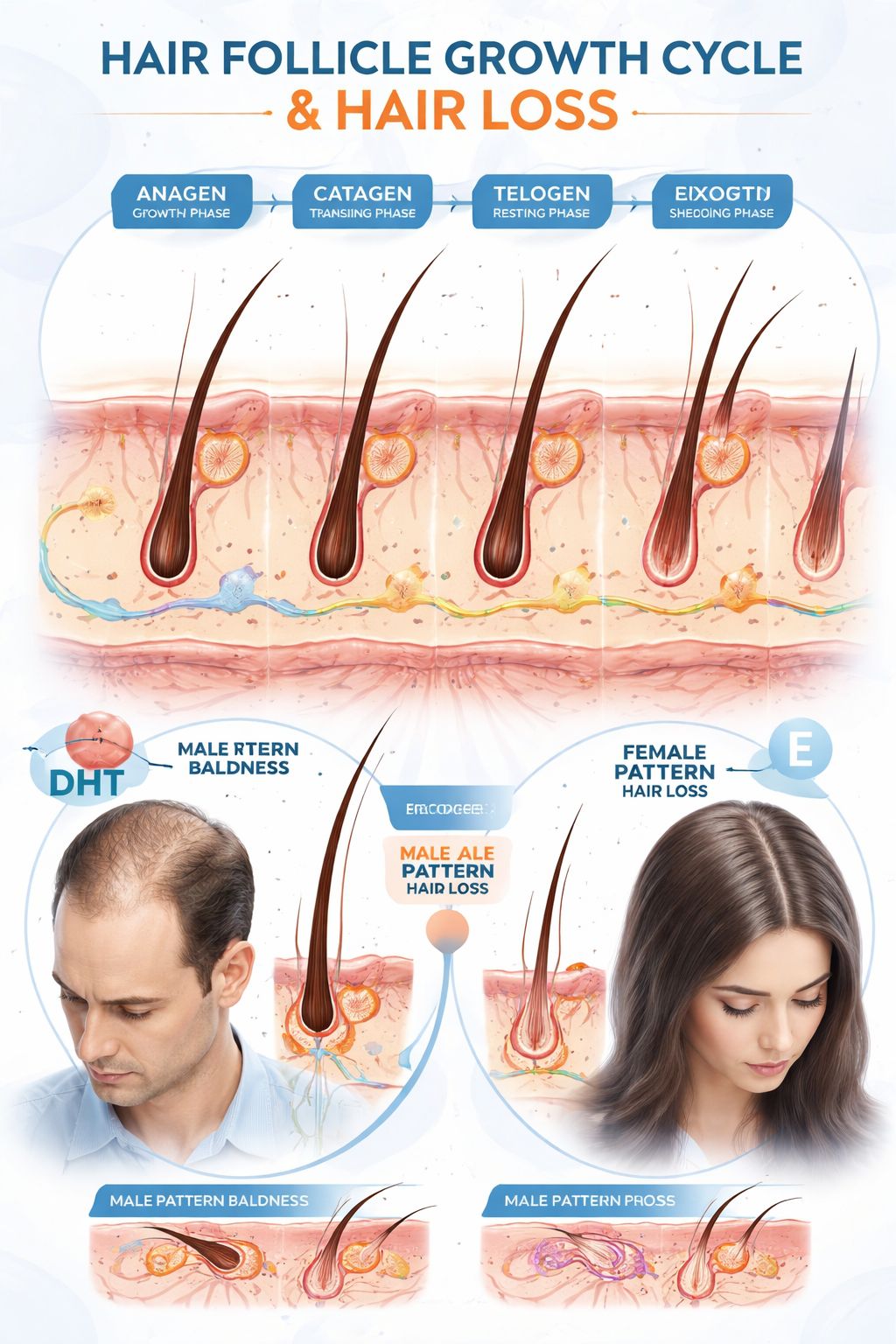
The hair follicle anatomy is surprisingly intricate. Each hair resides in a pocket-like indentation in the skin called the follicle. At the base of this follicle is the hair bulb, which contains the dermal papilla—the “command center” supplied with blood vessels that nourish the growing hair. Surrounding the hair shaft are various layers, including the inner and outer root sheaths and the sebaceous gland, which produces sebum to keep the hair conditioned. In healthy individuals, these follicles are robust and capable of producing thick, pigmented terminal hairs.
The Hair Growth Cycle Explained
Hair does not grow continuously; it moves through a rhythmic cycle of growth, transition, and rest. Disruptions at any stage of this cycle can lead to visible thinning.
- Anagen Phase: This is the active growth phase. Approximately 85-90% of the hairs on your scalp are in this stage at any given time. It can last anywhere from two to seven years, determining the maximum length of your hair.
- Catagen Phase: A short transitional phase lasting about two to three weeks. During this time, the hair follicle shrinks and detaches from the dermal papilla, cutting off the blood supply.
- Telogen Phase: The resting phase, lasting around three months. The old hair remains in the follicle while a new hair begins to form beneath it.
- Exogen Phase: This is the final stage where the old hair is eventually shed from the scalp to make room for the new growth.
Normal Hair Shedding vs Pathological Hair Loss
It is perfectly normal to lose between 50 and 100 hairs per day as part of the exogen phase. However, when the rate of shedding exceeds the rate of new growth, or when the new hairs produced are significantly thinner than the ones they replace, we categorize it as pathological hair loss. Identifying the difference is crucial for determining when medical intervention is necessary.
Pathophysiology of Male Pattern Hair Loss
The most common male pattern baldness causes are rooted in a condition known as Androgenetic Alopecia (AGA). This is a genetically predetermined sensitivity to certain hormones.
- Role of DHT: Dihydrotestosterone (DHT) is a byproduct of testosterone. In genetically susceptible men, DHT binds to receptors in the hair follicles, causing them to shrink.
- Follicular Miniaturization: Under the influence of DHT, the anagen phase shortens and the follicles produce progressively finer, shorter, and less pigmented hairs until they eventually stop producing hair altogether.
- Genetic Factors: AGA can be inherited from either the maternal or paternal side.
- Hamilton-Norwood Pattern: This scale is used to classify the stages of male hair loss, typically starting with a receding hairline and thinning at the vertex (crown).
Pathophysiology of Female Pattern Hair Loss
While men often see a receding hairline, female hair loss reasons usually manifest as diffuse thinning across the entire scalp, particularly at the part line.
- Hormonal Influences: While androgens play a role, the mechanism in women is often more complex, involving fluctuations in estrogen and progesterone, especially during menopause or PCOS.
- Ludwig Classification: This scale categorizes female hair loss into three grades, focusing on the density of hair at the crown while the frontal hairline often remains intact.
- Role of Estrogen / Androgens: Estrogen generally helps keep hair in the anagen phase longer. When estrogen levels drop, the protective effect is lost, making follicles more vulnerable to androgenic thinning.
Other Causes of Hair Loss in Men and Women
Beyond genetics, several other factors can trigger hair fall:
- Telogen Effluvium: A temporary condition where a significant stressor (surgery, high fever, or severe emotional stress) pushes a large number of hairs into the telogen phase simultaneously, leading to heavy shedding a few months later.
- Alopecia Areata: An autoimmune condition where the body’s immune system attacks the hair follicles, causing patchy hair loss.
- Nutritional Deficiencies: In the Indian context, deficiencies in Iron (Ferritin), Vitamin D, and B12 are incredibly common and can significantly impact hair quality.
- Thyroid Disease: Both hyperthyroidism and hypothyroidism can lead to dry, brittle hair and thinning.
- Stress / Illness / Medications: Chronic stress and certain medications (like those for blood pressure or cholesterol) can alter the hair cycle.
Why Hair Loss Patterns Differ Between Men and Women
The primary reason why hair falls in men and women differently lies in the distribution of androgen receptors and the enzymes that convert testosterone to DHT. Men have higher concentrations of these receptors in the frontal and crown areas, whereas women tend to have a more even distribution, leading to diffuse thinning rather than total baldness in specific spots.
Diagnostic Evaluation of Hair Loss
At Anant Aesthetic Clinic, we perform a thorough evaluation including a detailed medical history, a physical examination of the scalp (trichoscopy), and blood tests to rule out underlying systemic issues. A precise diagnosis is the cornerstone of any successful treatment plan.
Modern Treatment Options Based on Pathophysiology
Treatment is never “one size fits all.” It must be tailored to the specific cause identified during diagnosis.
- Medical Therapy: FDA-approved treatments like Minoxidil and Finasteride remain the gold standard for managing androgenetic alopecia by stimulating blood flow and blocking DHT.
- PRP (Platelet-Rich Plasma): A regenerative treatment where your own growth factors are injected into the scalp to revitalize miniaturized follicles.
- Hair Transplant: For permanent restoration, FUE (Follicular Unit Extraction) allows us to move healthy follicles from the back of the head to thinning areas.
- Nutritional Correction: Supplementing missing vitamins and minerals can often reverse thinning caused by deficiencies.
Frequently Asked Questions
Q: Can stress cause permanent baldness?
A: Usually, stress-induced hair loss (Telogen Effluvium) is temporary, but chronic stress can exacerbate underlying genetic thinning.
Q: Is hair loss reversible?
A: If caught early during the miniaturization phase, hair can often be thickened. Once a follicle has completely scarred over, a transplant is usually the only option.
Conclusion
Understanding the biological mechanisms of hair loss is the first step toward regaining your confidence. Whether you are dealing with genetic thinning or a temporary shedding phase, modern medical science offers effective solutions. We recommend consulting a specialist to identify the root cause of your hair loss before starting any treatment.
Dr. Sumit Toor
Anant Aesthetic Clinic, Adampur
www.anantaesthetics.com