

By Dr Sumit Toor
Understanding Laser Tattoo Removal: A Comprehensive Guide for Indian Patients
Tattoos are often intended to be permanent expressions of identity, art, or memory. However, as life evolves, so do our preferences. Whether it is for professional reasons—such as joining the Indian Armed Forces or civil services—social reasons, or simply a change in personal taste, the demand for Laser Tattoo Removal has seen a significant rise in India. As a board-certified aesthetic physician, I see many patients who are concerned about the safety and efficacy of removing ink from their skin. Fortunately, modern medical technology has made it possible to remove tattoos safely and effectively, provided the procedure is performed by a qualified professional using the right equipment.
The Science Behind Laser Tattoo Removal
The process of removing a tattoo is far more complex than simply “erasing” the ink. It relies on a scientific principle known as selective photothermolysis. When a tattoo is created, the ink particles are too large for your body’s immune system to remove, which is why they remain trapped in the dermis (the deeper layer of the skin).
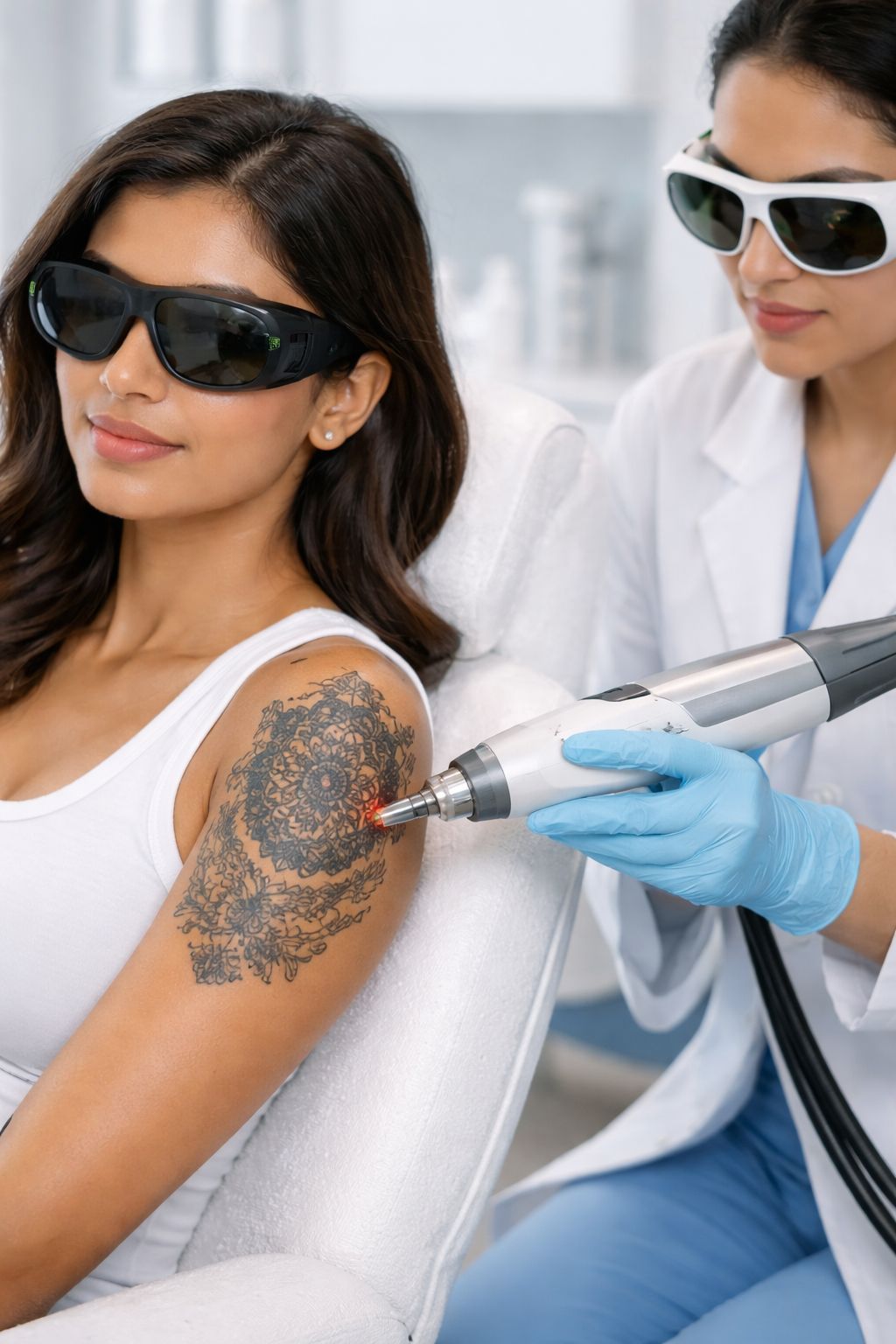
During a tattoo removal treatment, a high-intensity laser beam is directed at the tattooed area. The laser emits energy in incredibly short pulses. This energy is absorbed by the pigment of the tattoo but not by the surrounding skin. When the ink absorbs this energy, it undergoes rapid thermal expansion and shatters into tiny, microscopic fragments. Once the ink is fragmented, your body’s lymphatic system—specifically cells called macrophages—identifies these particles as waste and gradually carries them away to be processed and eliminated by the body over several weeks.
Types of Lasers Used in Modern Dermatology
Not all lasers are created equal, and the choice of technology is critical for success, especially for Indian skin types (typically Fitzpatrick IV to VI). The two primary categories of lasers used today are:
- Q-Switched Lasers: These have been the gold standard for years. They deliver energy in nanoseconds (billionths of a second). Common types include the Nd:YAG (1064nm for dark inks and 532nm for red/orange) and the Alexandrite (755nm for green/blue).
- Picosecond Lasers: This is the latest advancement in tattoo removal laser technology. These lasers deliver energy in picoseconds (trillionths of a second). This faster pulse creates a mechanical “photoacoustic” effect that shatters ink into even smaller particles than Q-switched lasers, often leading to faster results and fewer sessions.
The wavelength of the laser is vital because different colors of ink absorb different wavelengths of light. For example, black ink is the easiest to treat because it absorbs all laser wavelengths, whereas stubborn colors like neon green or yellow require very specific, specialized wavelengths.
The Step-by-Step Procedure: What to Expect
Undergoing a Laser Tattoo Removal procedure involves several distinct stages to ensure safety and the best possible outcome:
- Consultation and Skin Assessment: We begin by evaluating the tattoo’s age, location, ink density, and your skin type. We also review your medical history to ensure there are no contraindications.
- Patch Testing: Especially for patients with darker skin tones, a patch test is often performed on a small area to see how the skin reacts to the laser settings before proceeding with a full session.
- The Treatment Session: On the day of the procedure, the skin is cleaned. While many patients tolerate the sensation (often described as a rubber band snapping against the skin), we can apply a topical numbing cream or use a localized cooling device to minimize discomfort. The laser is then systematically applied over the tattoo.
- Cooling and Aftercare: Immediately after the laser pulses, the area may appear white (known as “frosting”). We apply a soothing ointment and a protective dressing to facilitate healing.
Factors Affecting Your Results
Several variables determine how quickly and completely a tattoo can be removed:
- Tattoo Age: Older tattoos are generally easier to remove because some of the ink has already been naturally broken down by the body over time.
- Ink Color: Black, dark blue, and red are the most responsive. Light blues, greens, and yellows are more challenging and may require more sessions.
- Ink Depth and Density: Professional tattoos usually have a higher density of ink and are placed deeper in the dermis compared to amateur “home-made” tattoos, making them more complex to remove.
- Skin Type: In the Indian context, we must be cautious with higher energy settings to avoid affecting the skin’s natural melanin, which could lead to pigment changes.
Number of Sessions Required
It is a common misconception that a tattoo can be removed in a single visit. Because the body needs time to clear the shattered ink particles, multiple sessions are mandatory. Most patients require anywhere from 6 to 12 sessions for significant clearance. These sessions are typically spaced 6 to 8 weeks apart. Rushing the process does not speed up removal; it only increases the risk of skin damage.
Who Is a Good Candidate?
Most healthy individuals are good candidates for Laser Tattoo Removal. However, the best candidates are those who:
- Have a strong immune system to help clear the ink.
- Do not smoke (smoking significantly slows down the healing and ink clearance process).
- Have realistic expectations about the timeline and the possibility of “ghosting” (a faint silhouette of the tattoo).
- Are committed to following strict post-procedure sun protection.
Risks and Potential Side Effects
While modern lasers are very safe, no medical procedure is without risk. Potential side effects include:
- Redness and Swelling: This is normal and usually subsides within a few days.
- Blistering: Small blisters may form; it is crucial not to pop them to avoid infection.
- Hypopigmentation or Hyperpigmentation: This is a change in skin color (lightening or darkening). This is a particular concern for Indian skin, which is why using the correct laser settings is vital.
- Scarring: The risk of scarring is very low (less than 5%) when the procedure is performed by an expert and aftercare is followed.
Tattoo Removal vs. Surgical Excision
While laser treatment is the preferred method for most, surgical excision is another option. Here is a quick comparison:
| Feature | Laser Tattoo Removal | Surgical Excision |
|---|---|---|
| Method | Non-invasive light energy | Invasive surgical cutting |
| Scarring | Minimal to none | Guaranteed linear scar |
| Best For | Large or multi-colored tattoos | Very small tattoos |
| Recovery | Minimal downtime | Sutures and wound healing |
Post-Procedure Care: Ensuring a Smooth Recovery
Your behavior after the treatment is just as important as the treatment itself. To remove tattoos safely and avoid complications, follow these steps:
- Keep it Clean: Apply the prescribed antibiotic ointment and keep the area covered for the first 24-48 hours.
- Hands Off: Do not pick at scabs or pop blisters. This is the leading cause of scarring and infection.
- Sun Protection: The treated area will be highly sensitive to the sun. Use a broad-spectrum SPF 50+ sunscreen and keep the area covered with clothing.
- Hydration: Drink plenty of water to help your lymphatic system flush out the ink particles.
Frequently Asked Questions (FAQs)
Is tattoo removal painful?
Most patients describe it as uncomfortable but manageable. We use cooling techniques and numbing creams to ensure the experience is as painless as possible.
Can all tattoo colors be removed?
While most colors can be significantly faded or removed, some pigments like vibrant yellow and certain shades of green are more resistant and may require specialized lasers.
Will it leave a scar?
When performed by a trained professional using medical-grade lasers, the risk of scarring is extremely low. Most “scars” associated with tattoo removal are actually pre-existing scars from when the tattoo was originally applied.
How long does complete removal take?
Depending on the size and complexity, the entire process can take 6 months to over a year, accounting for the necessary healing time between sessions.
Conclusion
Laser tattoo removal is a journey that requires patience, but with modern technology, it is a highly effective way to clear unwanted ink. By choosing a qualified clinic and following the recommended protocols, you can achieve excellent results while maintaining the health and integrity of your skin. If you are considering starting your removal journey, the first step is a professional consultation to create a customized treatment plan tailored to your specific tattoo and skin type.
Anant Aesthetic Clinic, Adampur