

By Dr Sumit Toor
Introduction: The Aesthetic Cost of Rapid Weight Loss
In recent years, India has witnessed a significant shift in how we approach weight management. With the global rise of GLP-1 receptor agonists like Semaglutide (often referred to by the brand name Ozempic) and the increasing accessibility of bariatric surgeries, thousands of individuals are achieving life-changing weight loss results. However, this rapid transformation often comes with an unexpected aesthetic trade-off: a phenomenon now widely known as “Ozempic Face.”
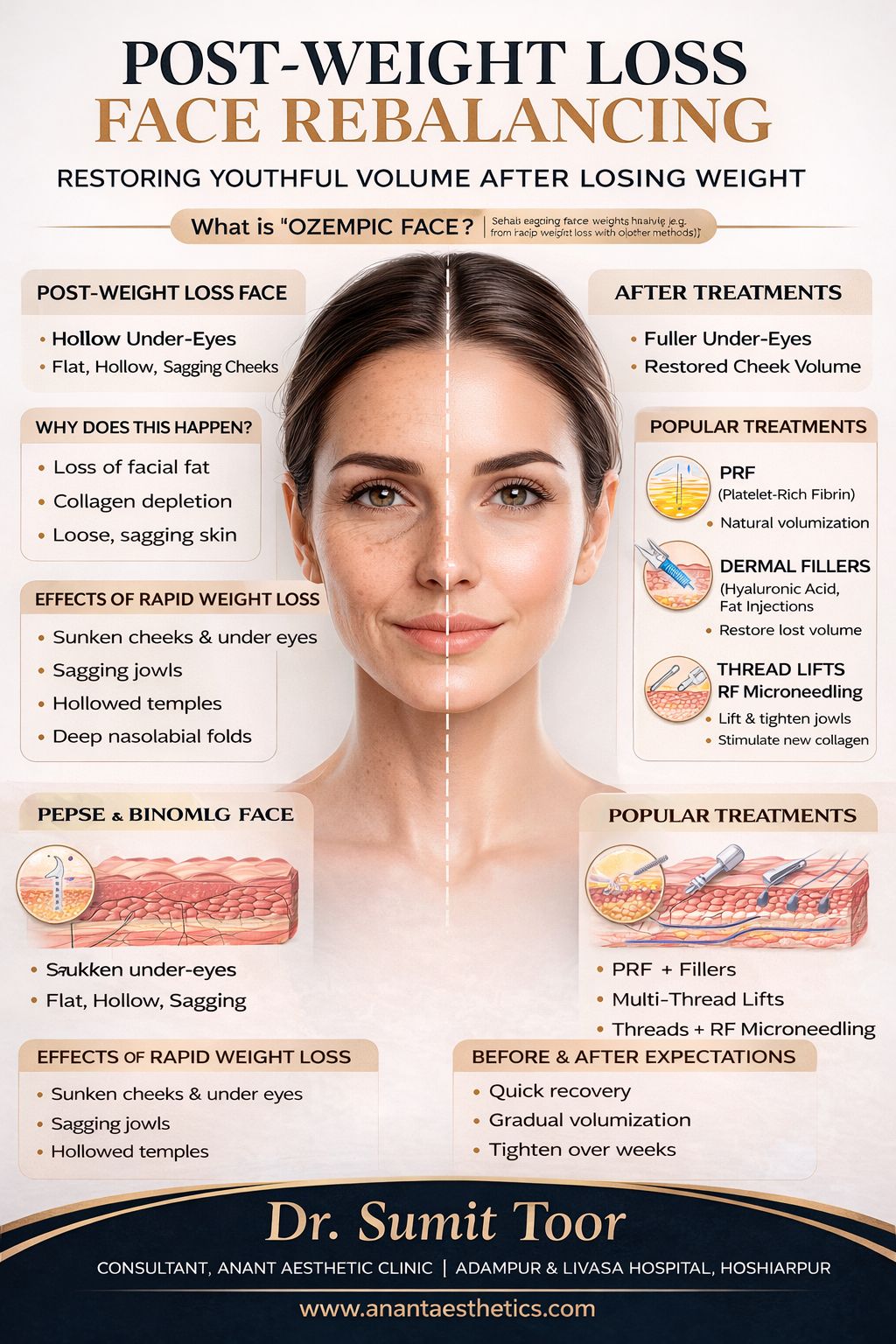
While losing weight improves metabolic health and body confidence, the face often bears the brunt of rapid fat depletion. When we lose weight quickly, the facial fat pads that provide structure and youthful volume vanish, leaving behind hollowed cheeks, sunken eyes, and sagging skin. Face rebalancing after weight loss has become a vital corrective approach, helping patients restore their natural features and look as healthy as they feel.
What Happens to the Face After Significant Weight Loss?
To understand how to fix the issue, we must first understand the anatomy of facial aging during weight loss. The human face is supported by several deep and superficial fat pads. These pads act as the “upholstery” of the face, keeping the skin taut and the contours rounded.
- Fat Pad Loss: Rapid weight loss causes these fat pads to shrink. The most noticeable changes occur in the midface (cheeks), the temples, and the delicate area under the eyes.
- Skin Laxity and Deflation: Think of the skin as a balloon. When the volume (fat) inside is suddenly removed, the “balloon” becomes wrinkled and saggy. Because the skin may not have enough elasticity to snap back, it begins to hang, leading to prominent jowls and nasolabial folds.
- Loss of Youthful Contours: The youthful “inverted triangle” of the face (wide at the top, narrow at the chin) often flips, becoming a standard triangle as volume shifts downward due to gravity.
What is “Face Rebalancing”?
Face rebalancing is a comprehensive aesthetic strategy designed to restore facial harmony. Rather than simply “filling” a single wrinkle, this approach looks at the face as a whole. The goal is to recreate the structural support that was lost during weight loss, ensuring the patient looks rejuvenated rather than “done.”
Effective face rebalancing focuses on three pillars:
- Volume Restoration: Replacing lost fat with biocompatible materials.
- Lifting: Repositioning sagging tissues to their original, higher location.
- Skin Quality Improvement: Addressing the thin, “crepy” texture that often follows rapid deflation.
Key Treatments Used in Combination
At professional aesthetic clinics, we find that a single treatment is rarely enough to address the complexities of “Ozempic Face.” Instead, we use a synergistic blend of PRF, Dermal Fillers, and Thread Lifts.
1. PRF (Platelet-Rich Fibrin)
PRF for facial rejuvenation is a next-generation treatment that uses the patient’s own blood to stimulate healing. Unlike its predecessor, PRP, PRF contains a higher concentration of platelets, white blood cells, and mesenchymal stem cells within a fibrin matrix. This matrix releases growth factors slowly over time.
In post-weight loss patients, PRF is invaluable for improving skin quality and thickening the delicate skin under the eyes, which often becomes translucent and dark after fat loss.
2. Dermal Fillers
Fillers after weight loss in India are the gold standard for immediate volume restoration. Using Hyaluronic Acid (HA) or biostimulatory fillers, we can rebuild the structural foundations of the face. Common areas for treatment include:
- The Temples: Filling hollow temples prevents a “skeletal” appearance.
- The Cheeks: Restoring the malar fat pad lifts the entire midface.
- The Jawline: Defining the jaw helps mask the appearance of mild jowls.
3. Thread Lifts (PDO)
When skin laxity is a primary concern, fillers alone can lead to an “overfilled” look. This is where PDO (Polydioxanone) Thread Lifts come in. These threads are inserted under the skin to mechanically lift sagging tissues. Over time, the threads dissolve, leaving behind a scaffold of newly formed collagen that maintains the lift naturally.
Why Combination Therapy Works Best
The secret to a successful Ozempic face treatment in India lies in the synergy of these modalities. If we only use fillers, we might use too much product, leading to a puffy appearance. If we only use threads, the face may look lifted but still “hollow.”
By combining them, we address every layer of aging:
- PRF works at the cellular level to improve the skin’s surface and health.
- Fillers provide the deep structural volume needed to support the skin.
- Threads provide the necessary tension and lift to counteract gravity.
Ideal Candidates for Face Rebalancing
This treatment protocol is specifically designed for individuals who have experienced a significant change in their facial structure due to weight fluctuations. Ideal candidates include:
- Patients who have lost 15kg or more through diet and exercise.
- Individuals using GLP-1 medications (Semaglutide, Tirzepatide).
- Post-bariatric surgery patients who are at a stable weight.
- Men and women typically aged 30–60 who notice premature sagging or hollowing.
The Treatment Planning Approach
No two faces age the same way, and weight loss affects everyone differently. A customized treatment plan is essential. During a consultation, your specialist will assess:
- The Degree of Volume Loss: Determining which fat pads have depleted the most.
- Skin Elasticity: Assessing if the skin can be supported by fillers or if a thread lift is required for mechanical support.
- Patient Expectations: Ensuring the goal is a natural, refreshed version of yourself.
Results and Timeline
One of the benefits of this combination approach is the blend of immediate and long-term results. Dermal fillers provide an instant “wow” factor, filling out hollows immediately. Thread lifts provide an instant lift, though the results improve over 2–3 months as collagen builds. PRF results are gradual, with skin texture and tone improving over several weeks.
Longevity: Fillers typically last 12–18 months, while thread lift results can be seen for 1–2 years. PRF is often recommended in a series of 3 sessions for optimal, long-lasting skin health.
Risks and Safety
While these are non-surgical procedures, they require a high level of medical expertise. Choosing an expert injector is paramount to avoid complications such as vascular occlusion, asymmetry, or infection. Common side effects are mild and include temporary swelling, bruising, or tenderness at the injection sites, which usually resolve within a few days.
Cost of Face Rebalancing in India
The cost of face rebalancing after weight loss varies based on the amount of product required and the complexity of the case. Below are approximate pricing ranges in India:
- PRF Sessions: ₹8,000 – ₹15,000 per session.
- Dermal Fillers: ₹25,000 – ₹45,000 per syringe (multiple syringes may be needed).
- Thread Lift Packages: ₹40,000 – ₹1,20,000 depending on the type and number of threads used.
Conclusion: Restoring Your Best Self
Weight loss is a monumental achievement for your health, and your face should reflect that vitality, not look depleted by it. Face rebalancing is not about changing who you are; it is about restoring the harmony and volume that weight loss took away. By focusing on natural restoration rather than overfilling, and utilizing a holistic assessment, we can help you achieve a look that is as vibrant and healthy as your new body.
Dr. Sumit Toor
Consultant at Anant Aesthetic Clinic, Adampur and Livasa Hospital, Hoshiarpur
Website: www.anantaesthetics.com