

By Dr Sumit Toor
Understanding Facial Rejuvenation in 2026
As we navigate 2026, the field of aesthetic medicine in India has reached new heights of precision and personalization. For patients looking to restore lost volume, smooth out wrinkles, or enhance facial contours, the choice often boils down to two primary treatments: Dermal Fillers and Fat Transfer (Fat Grafting). While both aim to rejuvenate the face, they utilize different mechanisms, offer varying longevities, and suit different patient profiles.
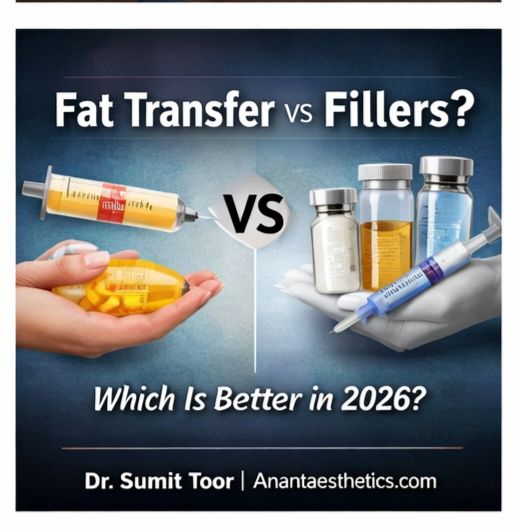
What are Dermal Fillers?
Dermal fillers are injectable substances designed to add volume and fullness to the skin. In 2026, the most common fillers are composed of Hyaluronic Acid (HA), a naturally occurring sugar molecule in the body that retains moisture. When injected, they provide immediate structural support and hydration to the treated area.
- Mechanism: Fillers act as a gel-like cushion, physically filling in lines or adding volume to areas like the cheeks, lips, and under-eyes.
- Procedure: A quick, office-based treatment involving fine needles or cannulas, usually completed within 15 to 30 minutes.
What is Fat Transfer (Fat Grafting)?
Fat transfer, also known as autologous fat grafting, is a surgical process where fat is harvested from one part of your body (like the abdomen or thighs) and moved to the face. This technique has gained immense popularity in 2026 due to its regenerative properties, as the transferred fat contains stem cells that improve skin quality over time.
- Mechanism: Your own living tissue is processed and re-injected into the face to restore volume naturally.
- Procedure: A two-step process involving minor liposuction to harvest the fat, followed by purification and injection into the target facial areas.
Key Differences at a Glance
Choosing between the two depends on your goals, budget, and willingness for downtime. Here is a comparison of how they stack up in 2026:
| Feature | Dermal Fillers | Fat Transfer |
|---|---|---|
| Longevity | Temporary (6–18 months) | Long-term / Permanent |
| Source | Synthetic/Biocompatible Gel | Your own body fat |
| Recovery | Minimal (0–2 days) | Moderate (7–14 days) |
| Initial Cost | Lower | Higher |
| Results | Instant | Gradual (settles in 3 months) |
Connect with Anant Aesthetics:
Pros and Cons
Dermal Fillers
Pros: No surgery required, instant results, reversible (if using HA fillers), and precise for fine lines.
Cons: Requires regular maintenance, can become expensive over many years, and carries a small risk of vascular complications if not performed by an expert.
Fat Transfer
Pros: Uses natural tissue (no allergy risk), provides a very soft and natural look, improves skin texture via stem cells, and is cost-effective for large-volume replacement over time.
Cons: Requires a surgical procedure (liposuction), results can be slightly unpredictable as some fat may be reabsorbed by the body, and involves more swelling and downtime.
Ideal Indications and Patient Selection
Choose Fillers if: You want a quick “refresh” for a specific event, you are targeting fine lines or lip enhancement, or you are not ready for a surgical procedure.
Choose Fat Transfer if: You have significant volume loss across the whole face (sunken cheeks, hollow temples), you want a permanent solution, or you are already undergoing another procedure like a facelift or liposuction.
Risks, Recovery, and Maintenance
Both procedures are safe when performed by a board-certified plastic surgeon. Fillers may cause temporary bruising or swelling. Fat transfer involves recovery at both the harvest site and the face; patients should expect swelling for about 1–2 weeks. While fillers need touch-ups every year, fat transfer results are generally stable once the initial “take” period (about 3 months) is over.
The Hybrid Approach: Combining Both
In 2026, many patients benefit from a combination. We may use fat transfer to provide a global volume foundation and then use dermal fillers for fine-tuning specific areas like the lip borders or very fine superficial wrinkles. This “Hybrid Rejuvenation” offers the best of both worlds.
Frequently Asked Questions (FAQs)
1. Is fat transfer painful?
The procedure is performed under local anesthesia or sedation, so you won’t feel pain during the process. Post-operative soreness is manageable with standard medication.
2. Can fillers look unnatural?
Only if overdone. At Anant Aesthetics, we follow a “less is more” philosophy to ensure you look like a refreshed version of yourself, never “done.”
3. How long does fat transfer last?
Once the transferred fat establishes a blood supply, it behaves like normal fat and can last for many years, though it will still age naturally with the rest of your face.
Conclusion
Whether you choose the convenience of fillers or the longevity of fat transfer, the key to a successful outcome is a personalized consultation. At Anant Aesthetics, we specialize in tailoring these advanced treatments to the unique facial structures of our Indian patients.
Ready to start your rejuvenation journey? Contact Dr. Sumit Toor at Anant Aesthetics today to discover which option is right for you.
Anant Aesthetic Clinic, Adampur