

By Dr Sumit Toor
Introduction
Scars are more than just physical marks; for many, they are reminders of past trauma, surgery, or injury that can affect self-esteem and physical comfort. Among the various types of scarring, hypertrophic scars are particularly common. These scars are characterized by their raised, red, and firm appearance, staying within the boundaries of the original wound. While they are not medically dangerous, their appearance and the potential for itching or restricted movement make effective scar management a priority for patients and clinicians alike.
At Anant Aesthetics, we often see patients seeking the most effective way to flatten and fade these marks. One of the gold-standard treatments in our arsenal is the Cica-Care gel sheet. However, a common question arises: is using a silicone gel sheet alone enough, or is a combined therapy approach necessary for the best results? In this article, we will explore the efficacy of Cica-Care both as a standalone treatment and as part of a multimodal strategy.
What is Cica-Care Gel Sheet?
Cica-Care is a widely recognized, self-adhesive silicone gel sheet designed for the management of both existing and new hypertrophic scars and keloids. Unlike simple bandages, these sheets are engineered with medical-grade silicone that provides a unique therapeutic environment for the skin.
Mechanism of Action
The effectiveness of Cica-Care lies in its three-fold mechanism:
- Occlusion: The sheet creates a semi-occlusive barrier over the scar. This prevents transepidermal water loss (TEWL), which is crucial because a dehydrated scar signals the body to produce more collagen, leading to the “raised” appearance of hypertrophic scars.
- Hydration: By trapping moisture, the sheet softens the scar tissue, making it more pliable and less prone to itching and discomfort.
- Collagen Modulation: The combination of pressure and hydration helps to normalize collagen synthesis. Instead of the chaotic, bundled collagen fibers found in hypertrophic scars, the environment encouraged by Cica-Care helps fibers align more naturally.
Indications and Advantages
Cica-Care is indicated for use on closed wounds to prevent hypertrophic scar treatment complications or to treat established scars. Its primary advantages include its durability (one sheet can last up to 28 days with proper cleaning), its ease of use, and the fact that it is non-invasive and painless, making it ideal for pediatric patients or those with sensitive skin.
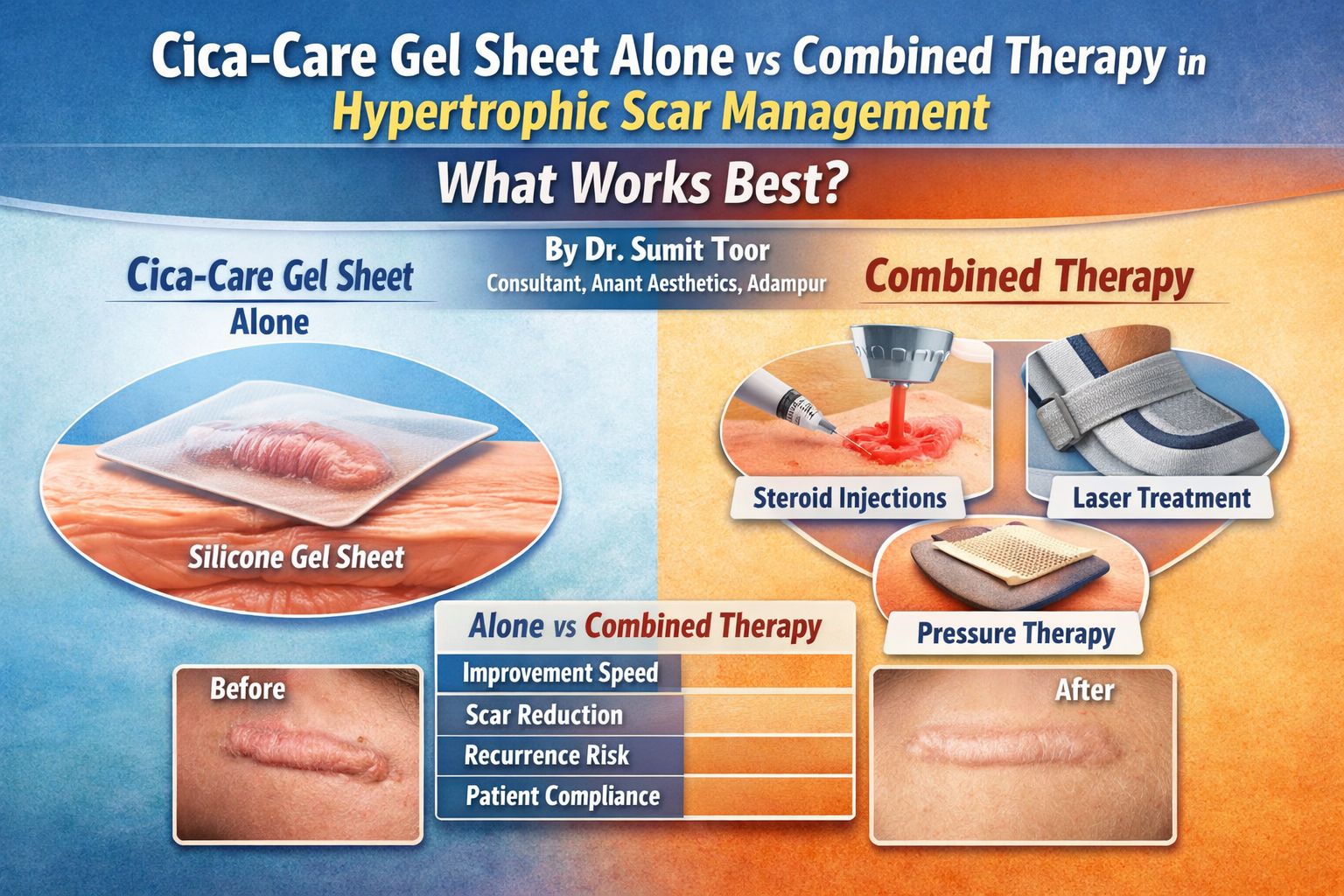
Cica-Care Gel Sheet Used Alone
For many patients, particularly those with mild to moderate hypertrophic scars that are relatively fresh (less than six months old), using Cica-Care as a monotherapy is highly effective.
Effectiveness and Clinical Outcomes
When used alone, Cica-Care has a high success rate in flattening scars and reducing redness. Clinical studies have shown that up to 90% of scars improve in appearance when silicone gel sheets are applied consistently. Patients can typically expect to see the first signs of softening within 2 to 4 weeks, with significant flattening occurring over a 2 to 4-month period.
Pros and Limitations
Pros:
- Cost-effective compared to clinical procedures.
- Can be managed entirely at home.
- No risk of the side effects associated with injections or lasers.
Limitations:
- Requires high patient compliance (must be worn 12–24 hours a day).
- May be slow to show results on older, very thick, or “mature” scars.
- Can be difficult to apply on highly mobile joints or contoured areas of the face.
Combined Therapy Approach
In cases of moderate to severe scarring, or when a patient desires faster results, we often recommend a multimodal approach. Combining silicone gel sheets with other medical interventions can target the scar from multiple biological angles.
Cica-Care + Intralesional Steroids
This is perhaps the most common combination. We inject a corticosteroid (like Triamcinolone) directly into the scar tissue to reduce inflammation and inhibit collagen overgrowth. Following the injection with Cica-Care gel sheets helps maintain the flattening effect and prevents the “rebound” growth that sometimes occurs after steroid treatments.
Cica-Care + Silicone Gel + Pressure Therapy
For large areas, such as burn scars, we may use Cica-Care underneath pressure garments. The mechanical pressure of the garment works synergistically with the hydration of the silicone sheet to accelerate the remodeling of the scar tissue.
Cica-Care + Laser Therapy (Fractional CO₂)
Fractional CO₂ lasers create microscopic channels in the scar to stimulate deep remodeling. Using Cica-Care during the post-laser healing phase (once the skin has re-epithelialized) ensures the new collagen forms in a hydrated, controlled environment, significantly improving the final texture and color of the scar.
Comparison: Alone vs. Combined Therapy
Choosing between these two paths depends on the scar’s age, thickness, and the patient’s lifestyle. Below is a comparison to help guide the decision-making process.
| Feature | Cica-Care Alone | Combined Therapy |
|---|---|---|
| Speed of Improvement | Gradual (2–6 months) | Rapid (1–3 months) |
| Scar Thickness Reduction | Moderate | Significant/High |
| Recurrence Rates | Low (if used long-term) | Very Low |
| Patient Compliance | Requires daily discipline | Requires clinic visits + daily care |
| Cost | Lower | Higher |
Patient Case Example
Patient: A 32-year-old male with a 4-month-old hypertrophic scar on the forearm resulting from a kitchen accident. The scar was raised, itchy, and bright red.
Treatment: We initially prescribed Cica-Care gel sheets alone. After 8 weeks, the scar had softened and the itching had stopped, but the height of the scar remained significant. We then shifted to a combined therapy of two sessions of intralesional steroid injections spaced 4 weeks apart, while continuing Cica-Care daily.
Result: By the end of month 4, the scar was 80% flatter and had faded from bright red to a pale pink, blending much more naturally with the surrounding skin. The patient reported high satisfaction with the combined approach.
Clinical Recommendations
As a consultant, my recommendations are tailored to the individual, but general guidelines apply:
- When to use Cica-Care alone: For new scars (post-surgery or injury) that are just beginning to show signs of thickening, or for patients who prefer a non-invasive, needle-free approach.
- When to shift to combined therapy: If the scar is older than one year, if it is a true keloid (growing beyond the wound boundaries), or if there is no visible improvement after 2 months of consistent Cica-Care use.
Practical Tips for Patients
To get the most out of your hypertrophic scar treatment, follow these practical steps:
- Duration of Use: Start by wearing the sheet for 4 hours a day, increasing by 2 hours each day until you reach a minimum of 12 hours. Ideally, the sheet should be worn 24 hours a day, except during cleaning.
- Proper Application: Ensure the scar and surrounding skin are clean and dry. Do not use creams or ointments under the sheet, as this will interfere with adhesion and the therapeutic effect.
- Cleaning: Wash the sheet twice daily with a mild, non-oily soap and rinse in clean, warm water. Let it air dry.
- Do’s and Don’ts: Do be patient; scar remodeling takes time. Don’t use on open or infected wounds. Do trim the sheet so it overlaps the scar by at least half an inch.
FAQ: Frequently Asked Questions
1. What is the main difference between a keloid vs hypertrophic scar?
A hypertrophic scar stays within the boundaries of the original wound and may regress over time. A keloid grows beyond the original wound site and rarely disappears on its own.
2. Can I reuse a Cica-Care gel sheet?
Yes, Cica-Care is designed to be washed and reused. One piece typically lasts between 14 to 28 days depending on the area of the body and care taken.
3. Is it safe to use Cica-Care on children?
Absolutely. It is a non-invasive, painless treatment that is very well-tolerated by children.
4. Can I use Cica-Care as soon as my surgery is over?
You must wait until the sutures are removed and the wound is completely closed with no scabbing or oozing before applying the gel sheet.
5. Will Cica-Care make my scar disappear completely?
While no treatment can make a scar 100% invisible, Cica-Care can significantly flatten, soften, and fade the scar so that it is much less noticeable.
Conclusion
In the debate of Cica-Care alone vs. combined therapy, the “best” choice is the one that matches the severity of the scar and the patient’s goals. Cica-Care gel sheets are an incredibly effective, evidence-based tool for scar management. For mild cases, they are often all that is needed. However, for stubborn or severe hypertrophic scars, combining silicone technology with clinical interventions like steroids or lasers offers the most comprehensive path to skin restoration.
If you are struggling with a scar that affects your confidence, I encourage you to seek a professional consultation to determine the best strategy for your skin.
Dr. Sumit Toor
Consultant, Anant Aesthetics, Adampur
Website: www.anantaesthetics.com