

By Dr Sumit Toor
Introduction
Keloids represent one of the most challenging conditions in dermatological practice. Unlike a standard scar that stays within the boundaries of the original wound, a keloid is an aggressive overgrowth of dense fibrous tissue that extends beyond the initial site of injury. These lesions are not merely cosmetic concerns; they are often accompanied by physical discomfort, including persistent itching, tenderness, and even sharp pain. Because keloids have a notorious reputation for recurring after surgical excision, non-surgical intralesional therapy has become the gold standard for management.
Among the various treatments available, triamcinolone injection (a corticosteroid) has been the traditional first-line therapy for decades. However, as our understanding of scar biology has evolved, many specialists are turning toward combination therapies. Specifically, the addition of 5-Fluorouracil (5-FU) to triamcinolone has shown remarkable promise. In this article, we will explore the differences between these two approaches to help patients and clinicians determine the most effective path for keloid resolution.
Understanding Triamcinolone (Steroid Therapy)
Triamcinolone acetonide is a potent corticosteroid used widely in keloid treatment. When injected directly into the scar tissue, it works through several biological pathways to reduce the scar’s bulk and symptoms.
Mechanism of Action
Triamcinolone functions primarily as an anti-inflammatory agent. It inhibits the migration of inflammatory cells and suppresses the activity of fibroblasts—the cells responsible for producing collagen. By reducing the production of collagen and increasing the levels of collagenase (an enzyme that breaks down collagen), triamcinolone helps to soften and flatten the raised tissue.
Benefits and Typical Outcomes
For many patients, triamcinolone injections provide rapid relief from the intense itching and pain associated with active keloids. Over a series of sessions, the scar typically becomes softer and less prominent. It is a widely available, cost-effective treatment that most practitioners are comfortable administering.
Limitations and Side Effects
Despite its benefits, steroid monotherapy has significant drawbacks. The recurrence rate when using triamcinolone alone can be as high as 30% to 50%. Furthermore, repeated high-dose injections can lead to local side effects, such as:
- Skin Atrophy: Thinning of the skin around the injection site.
- Telangiectasia: The appearance of small, visible spider veins on the scar surface.
- Hypopigmentation: Lightening of the skin color, which can be particularly noticeable in patients with darker skin tones.
What is 5-Fluorouracil (5-FU)?
Originally developed as a chemotherapy medication, 5-Fluorouracil (5-FU) has found a vital second life in the world of scar modulation. In the context of intralesional therapy for scars, it is used in much lower concentrations than in cancer treatment.
Mechanism of Action
5-FU is an antimetabolite that interferes with DNA and RNA synthesis. In a keloid, it specifically targets rapidly dividing fibroblasts. By inhibiting these cells, 5-FU effectively shuts down the “machinery” that produces excess collagen. Unlike steroids, which primarily manage inflammation, 5-FU directly addresses the cellular overactivity that causes the keloid to grow.
Role in Scar Modulation
5-FU is particularly effective at preventing the recurrence of scars after they have been flattened. It helps “reset” the healing process, ensuring that the body does not return to a state of over-active scar production.
Triamcinolone Alone in Keloid Management
While combination therapy is gaining popularity, triamcinolone monotherapy still has a place in clinical practice.
Indications
Steroid injections alone are often recommended for small, relatively new keloids that are soft to the touch. They are also a starting point for patients who may have contraindications to 5-FU, such as pregnancy or specific blood disorders.
Expected Results and Timeline
Patients usually require injections every 4 to 6 weeks. Significant flattening is often observed after 3 to 5 sessions. However, if the keloid is older or very firm, steroids alone may reach a “plateau” where no further improvement is seen.
Combination Therapy: Triamcinolone + 5-FU
The most significant advancement in 5-FU keloid management is the synergistic use of both medications in a single injection. This “cocktail” approach leverages the strengths of both drugs while minimizing their individual side effects.
The Synergistic Effect
When combined, 5-FU handles the inhibition of cell growth, while triamcinolone manages the inflammation and counteracts the potential inflammatory response caused by 5-FU. Interestingly, the steroid also helps prevent the skin ulceration that can sometimes occur when 5-FU is used alone, while the 5-FU reduces the risk of skin thinning and spider veins associated with high-dose steroids.
Protocol and Clinical Outcomes
A common protocol involves a mixture of 90% 5-FU (50mg/ml) and 10% Triamcinolone (40mg/ml). This ratio provides a powerful punch against the scar tissue. Clinical studies consistently show that this combination results in faster flattening, better patient satisfaction, and a significantly lower chance of the keloid returning compared to using steroids alone.
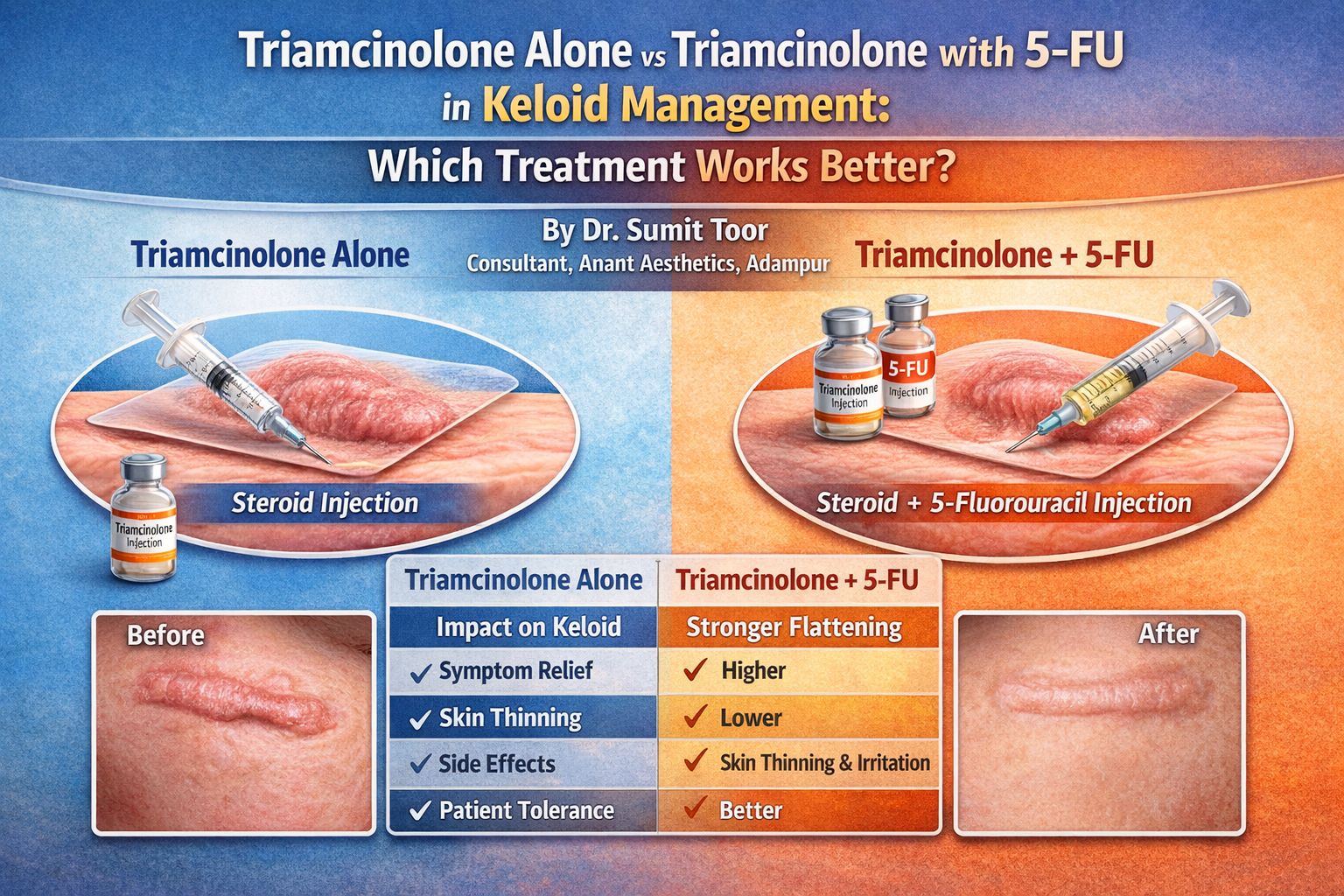
Comparison: Triamcinolone Alone vs. Combination Therapy
When we look at the data, the combination of Triamcinolone and 5-FU consistently outperforms monotherapy in several key metrics.
| Feature | Triamcinolone (TAC) Alone | TAC + 5-Fluorouracil (5-FU) |
|---|---|---|
| Primary Action | Anti-inflammatory & collagen suppression | Fibroblast inhibition + Anti-inflammatory |
| Efficacy (Flattening) | Moderate; may plateau | High; effective on stubborn scars |
| Recurrence Rate | Higher (approx. 30-50%) | Lower (approx. 10-20%) |
| Side Effect Profile | Risk of skin thinning & spider veins | Lower risk of atrophy; mild injection site pain |
| Patient Tolerance | Generally well-tolerated | Well-tolerated; faster results |
Clinical Recommendations
As a consultant at Anant Aesthetics, I tailor the treatment plan to the individual characteristics of the scar. However, general guidelines include:
- When to use steroid alone: For very small, early-stage keloids or in patients where 5-FU is medically contraindicated.
- When combination therapy is preferred: For large, firm, or long-standing keloids, and especially for recurrent keloids that have failed previous steroid treatments. It is also the preferred choice for patients who want to minimize the risk of skin thinning.
Case Example: A Real-World Scenario
Consider a 28-year-old patient who presented with a firm, itchy keloid on the chest following a minor acne lesion. The patient had previously undergone six sessions of triamcinolone injections elsewhere with only 30% flattening and significant skin thinning (atrophy) around the scar. We switched the protocol to a combination of Triamcinolone and 5-FU. After just three sessions, the scar flattened completely, the itching vanished, and the surrounding skin health began to stabilize. This case demonstrates how combination therapy can overcome the limitations of steroids alone.
Patient Guidance: What to Expect
If you are considering intralesional therapy for scars, here is what you should know about the process:
- Number of Sessions: Most patients require between 4 and 8 sessions, spaced 4 to 6 weeks apart.
- The Procedure: The injections can be slightly uncomfortable as the tissue is very dense. We often use topical numbing cream or ice to minimize discomfort.
- Aftercare: Avoid direct sun exposure on the treated area, as this can cause hyperpigmentation. Gentle massage of the scar as it softens can also help the medication distribute evenly.
- Monitoring: We monitor the scar closely for any signs of ulceration or pigment changes at each visit.
Conclusion
While triamcinolone remains a foundational tool in keloid management, the evidence clearly favors combination therapy with 5-FU for superior efficacy and lower recurrence rates. By combining these two powerful agents, we can achieve flatter, more comfortable scars with fewer side effects. If you are struggling with a persistent keloid, a consultation to discuss combination therapy may be the key to finally achieving the results you desire.
Frequently Asked Questions (FAQs)
1. Are 5-FU injections safe?
Yes. While 5-FU is used in high doses for chemotherapy, the amount used for keloid injections is very small and acts locally within the scar. Systemic side effects are extremely rare.
2. How soon will I see results?
Most patients notice a reduction in itching and pain after the first session. Visible flattening usually begins after the second or third injection.
3. Can keloids be permanently cured?
While “cure” is a strong word for keloids, combination therapy offers the best chance for long-term remission. Regular follow-ups are essential to catch any early signs of recurrence.
4. Does the injection hurt?
Because keloid tissue is tough, the injection can be briefly painful. However, the procedure is very quick, and we use various techniques to ensure patient comfort.
5. Is this treatment suitable for all skin types?
Yes, but patients with darker skin tones must be monitored closely for pigment changes. The combination approach is often safer for these patients as it requires lower doses of steroids.
Dr. Sumit Toor
Consultant, Anant Aesthetics, Adampur
Website: www.anantaesthetics.com