

By Dr Sumit Toor
Hair loss is a deeply personal journey that affects millions of men and women worldwide. The most common cause, androgenetic alopecia (often called male or female pattern baldness), can impact self-esteem and confidence. Fortunately, the field of hair restoration has evolved rapidly. While hair transplants were once the only definitive solution, modern science has introduced non-surgical alternatives like Platelet-Rich Plasma (PRP) and Exosome therapy. Understanding the differences between these options is the first step toward finding the best treatment for hair loss tailored to your needs.
Understanding the Basics: How These Treatments Work
To choose the right path, it is essential to understand the scientific mechanisms behind each procedure. Each method targets hair follicles differently, ranging from biological stimulation to surgical relocation.
1. PRP (Platelet-Rich Plasma)
PRP is an autologous therapy, meaning it is derived from your own blood. During a session, a small amount of blood is drawn and spun in a centrifuge to concentrate the platelets. These platelets are rich in growth factors that, when injected into the scalp, stimulate hair follicles, improve blood flow (angiogenesis), and reduce inflammation.
- The Evidence: PRP is well-established in clinical practice. Multiple studies show that approximately 80% of patients see an improvement in hair density and thickness.
2. Exosome Therapy
Exosomes represent the next generation of regenerative medicine. Unlike PRP, exosomes are cell-free extracellular vesicles derived from stem cells. Think of them as tiny messengers that carry high concentrations of proteins, lipids, and genetic material directly to your cells.
- Mechanism: Exosomes activate dermal papilla cells, which are responsible for hair growth. They help push hair follicles into the “anagen” (growth) phase and protect cells from premature death (apoptosis).
- The Evidence: While still in the early stages of widespread use, early reports show promising increases in hair density (ranging from 9.5 to 35 hairs per square centimeter).
3. Hair Transplant
A hair transplant is a surgical procedure that involves moving hair follicles from a “donor site” (usually the back of the head where hair is resistant to thinning) to the balding areas. The two most common techniques are Follicular Unit Extraction (FUE) and Follicular Unit Transplantation (FUT).
- Mechanism: This is a permanent redistribution of healthy, DHT-resistant follicles to areas where hair has stopped growing.
Comparing Your Options
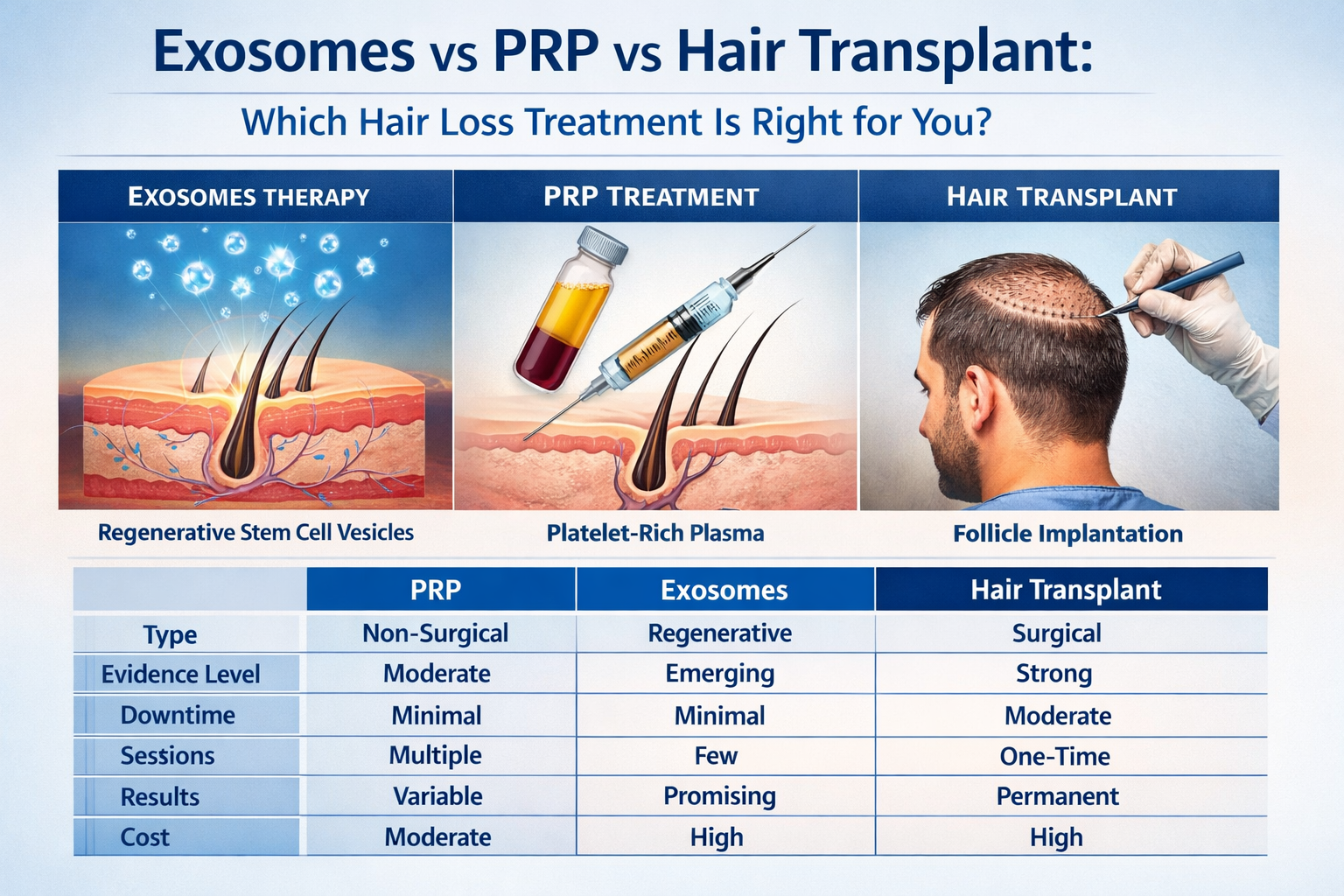
When weighing hair transplant vs PRP or exosomes, it helps to see the facts side-by-side. Use the table below to compare the key features of each treatment.
| Feature | PRP | Exosomes | Hair Transplant |
|---|---|---|---|
| Type | Non-surgical | Advanced regenerative | Surgical |
| Evidence Level | Moderate | Emerging | Strong |
| Downtime | Minimal | Minimal | Moderate (7-10 days) |
| Sessions | Multiple (3-6+) | Few (4-5) | One-time |
| Results | Variable | Promising | Permanent |
| Cost | Moderate | High | High |
Indications: What to Choose and When?
The right choice depends largely on the current stage of your hair loss. Doctors often use the Norwood Scale (for men) or Ludwig Scale (for women) to determine the best course of action.
Choose PRP when:
- You are in the early stages of thinning (Grade I–III).
- You prefer a natural, low-risk option using your own biology.
- You need maintenance therapy to keep existing hair healthy.
Choose Exosomes when:
- You have tried PRP but did not see the desired results (non-responders).
- You have moderate hair loss and need a stronger regenerative boost.
- You are looking for the latest “next-gen” biotechnology.
Choose a Hair Transplant when:
- You have advanced baldness (Grade IV–VII).
- Hair follicles in the area are completely dormant or dead (irreversible loss).
- You want a permanent restoration of hair density.
The Power of the Combination Approach
In modern aesthetics, it is rarely a matter of choosing just one treatment. Many specialists now recommend a combination strategy for the best results. For example, using PRP or Exosomes immediately after a hair transplant can significantly improve graft survival and speed up the healing process. Combining regenerative therapies with surgery is currently considered the gold standard for comprehensive hair restoration.
Limitations and Reality Check
While these treatments are highly effective, it is important to have realistic expectations:
- PRP: Results can vary because they depend on the quality of your own blood and platelets.
- Exosomes: As a newer therapy, there is still a lack of global standardization in how they are manufactured and applied.
- Transplant: Success depends heavily on the surgeon’s expertise and the amount of healthy donor hair you have available.
The Future of Hair Restoration
We are entering an era of personalized hair care. The future likely holds more cell-free regenerative options like exosomes, AI-based analysis to predict hair loss patterns, and highly customized protocols that mix PRP, exosomes, and topical medications for a “cocktail” approach tailored to each patient’s DNA.
Frequently Asked Questions
Is PRP better than exosomes?
Not necessarily “better,” but different. PRP uses your own blood, while exosomes are a more concentrated, lab-derived regenerative product. Exosomes may be more potent for those who don’t respond to PRP.
Are exosomes safe?
Yes, when sourced from reputable, FDA-compliant labs and administered by professionals, exosome therapy is considered safe and minimally invasive.
Can I avoid a transplant with PRP?
If caught early, PRP can significantly delay the need for a transplant by strengthening existing hair. However, it cannot regrow hair in areas that are completely bald.
How long do results last?
PRP and Exosomes require maintenance sessions (usually once or twice a year). Hair transplant results are permanent, though the surrounding non-transplanted hair may continue to thin over time.
Which is the best treatment for hair loss?
The “best” treatment is the one that matches your specific grade of hair loss and your long-term goals. A consultation is necessary to determine this.
Conclusion
There is no one-size-fits-all solution for hair restoration. Whether you choose PRP vs Exosomes for hair loss or opt for a surgical transplant, your decision should be based on your age, the extent of your thinning, and your personal expectations. To ensure the best outcome, consult a qualified plastic surgeon or hair restoration specialist for personalized advice and a treatment plan designed just for you.