

By Dr. Sumit Toor
Abstract
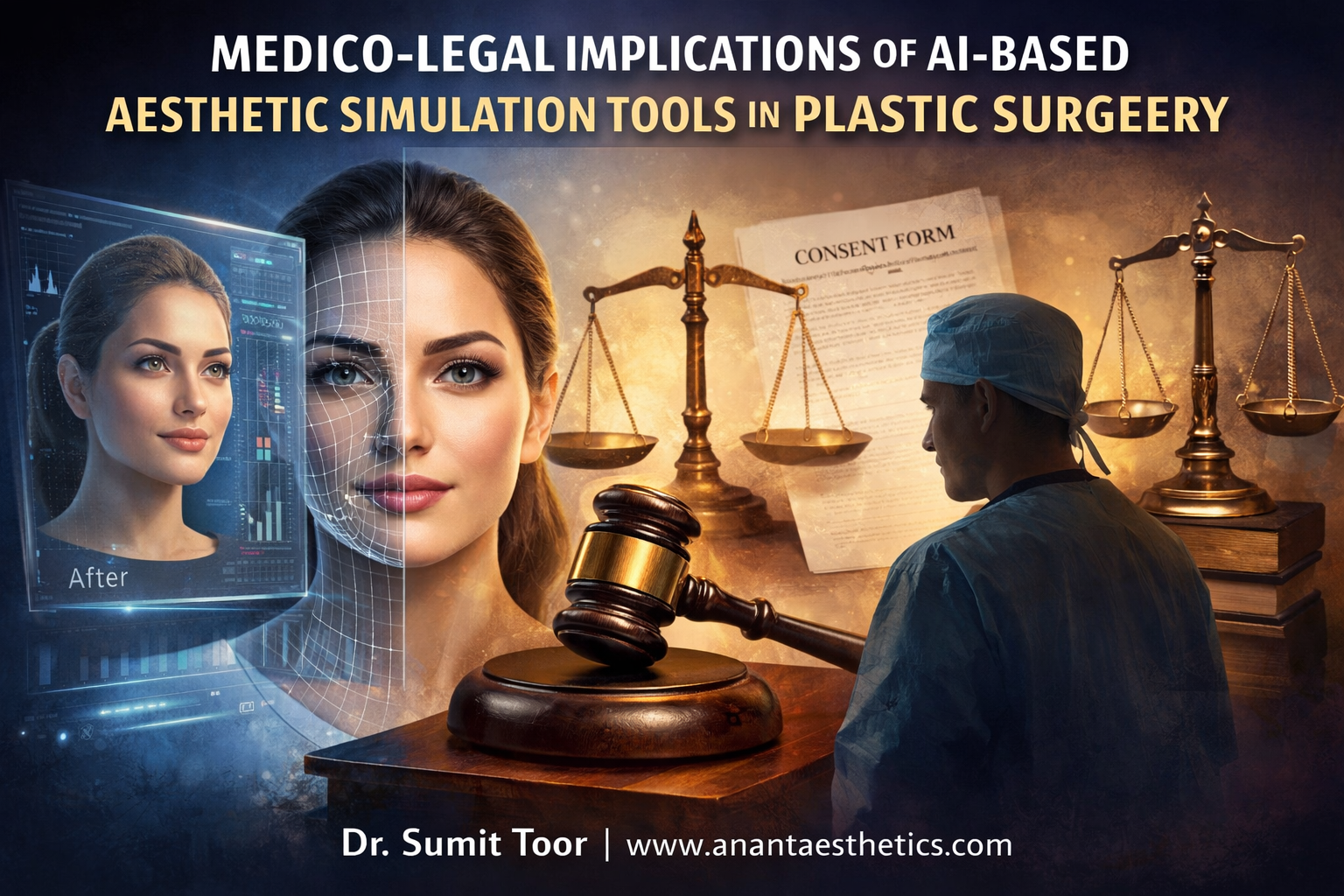
The integration of Artificial Intelligence (AI) into aesthetic plastic surgery has ushered in a new era of patient consultation, characterized by sophisticated predictive modeling and facial simulation tools. While these technologies, such as GreatLooks.ai, offer significant benefits in patient education and expectation management, they simultaneously introduce a complex array of medico-legal challenges. This article examines the clinical utility of AI-based simulations, the inherent risks of misrepresentation and liability, and the evolving landscape of informed consent. Furthermore, it provides a specific analysis of the Indian medico-legal framework and offers practical risk-mitigation strategies for practitioners. As AI becomes a staple in the surgical suite, balancing technological innovation with ethical responsibility and legal diligence is paramount for the modern aesthetic surgeon.
Introduction
The field of plastic surgery has always been at the intersection of art and science. In recent years, the “science” component has been significantly bolstered by the rise of Artificial Intelligence. AI-based facial simulation tools have transitioned from novel curiosities to essential components of the aesthetic consultation. These tools allow surgeons to provide patients with a visual projection of potential post-operative results, moving beyond the limitations of traditional 2D morphing software.
By utilizing deep learning algorithms, these platforms can analyze a patient’s unique anatomy and simulate the effects of various procedures, from rhinoplasty to soft tissue fillers. However, as these simulations become more realistic, the line between a “predictive tool” and a “guaranteed outcome” begins to blur. For the practitioner, this technological leap necessitates a thorough understanding of the medico-legal implications that accompany the digital rendering of the human form.
Clinical Utility of AI Simulation Tools
The primary value of AI simulation lies in its ability to enhance communication. In aesthetic surgery, the most common cause of patient dissatisfaction is not necessarily a poor surgical result, but a “perception-reality gap”—where the patient’s expectations do not align with the achievable surgical outcome.
- Patient Education: AI tools help patients visualize anatomical constraints. For instance, showing how a specific nasal bridge height interacts with the forehead contour provides a level of clarity that verbal descriptions cannot match.
- Expectation Alignment: By adjusting simulations in real-time, surgeons can temper unrealistic desires, showing the patient why a certain look may not be harmonious with their existing features.
- Practice Growth and Marketing: In a competitive market, providing a high-tech, interactive consultation experience can significantly improve patient conversion rates and build trust through transparency.
Medico-Legal Risks
Despite their benefits, AI simulations are fraught with legal pitfalls. The most significant risk is the misrepresentation of outcomes. If a patient perceives the AI-generated image as a “contractual promise” of the final result, any deviation—no matter how clinically acceptable—could be grounds for a legal claim of breach of contract or negligence.
Unrealistic Patient Expectations: Paradoxically, while AI can align expectations, it can also inflate them. If an algorithm produces a result that is biologically impossible due to skin elasticity, scarring, or underlying bone structure, the surgeon may be held liable for failing to disclose the limitations of the technology.
Liability in Case of Dissatisfaction: When a patient is unhappy with their results, the AI simulation often becomes “Exhibit A.” If the surgical outcome differs significantly from the simulation, the burden of proof may shift to the surgeon to explain why the predicted result was not achieved.
Data Privacy and Consent: AI tools require the uploading of high-resolution facial images to cloud-based servers. This raises significant concerns regarding data security, patient anonymity, and compliance with international data protection regulations (such as GDPR) and local laws.
Informed Consent in the AI Era
The traditional informed consent process must evolve to include the use of AI. It is no longer sufficient to discuss the risks of anesthesia and infection; surgeons must now address the risks of digital simulation. Practitioners should consider whether AI-generated images should be physically or digitally attached to the consent form.
Documentation Strategies: Every simulation shown to a patient should be saved in their Electronic Medical Record (EMR). This creates a paper trail of what was discussed and what the patient agreed to. It is vital to document that the patient understands the simulation is a mathematical estimation and not a biological certainty.
Ethical Considerations
Ethical practice in the age of AI requires a critical look at the algorithms themselves. Algorithmic Bias is a documented concern; if an AI is trained primarily on a specific demographic, its predictions for patients of different ethnicities or skin types may be inaccurate or culturally insensitive.
Furthermore, there is the risk of over-promising. Surgeons must resist the temptation to use “idealized” AI settings to close a sale. Maintaining surgeon autonomy is also crucial—the practitioner must ensure that the AI is an assistant to their clinical judgment, not a replacement for it. If an AI suggests a result the surgeon knows they cannot achieve, the surgeon has an ethical obligation to override the tool.
Indian Medico-Legal Perspective
In the Indian context, the legal landscape is governed largely by the Consumer Protection Act (CPA), 2019, and the guidelines set forth by the National Medical Commission (NMC). Under the CPA, medical services are considered a “service,” and patients are “consumers.” Any perceived gap between the promised result (the AI simulation) and the actual result can be interpreted as a “deficiency in service.”
Indian courts have historically applied the Bolam Test to determine medical negligence, focusing on whether the doctor acted in accordance with a responsible body of medical opinion. However, with the rise of visual evidence, the Montgomery standard—which emphasizes the patient’s right to know all material risks—is becoming more relevant. If a surgeon uses AI to show a result but fails to explain the high probability of variance, they may be vulnerable under Indian law.
Risk Mitigation Strategies for Practitioners
To protect themselves and their patients, practitioners should implement rigorous protocols:
- Standard Disclaimers: Every AI-generated image should be watermarked or accompanied by a clear disclaimer.
- Patient Counseling: Use the simulation as a starting point for a conversation about limitations, not as a final destination.
- Documentation: Ensure that the patient signs a specific addendum acknowledging the nature of AI simulations.
Sample Disclaimer Text:
“The images provided are computer-generated simulations intended for educational and illustrative purposes only. They represent a mathematical prediction of potential results and do not constitute a guarantee, warranty, or contractual agreement regarding the final surgical outcome. Individual biological variations, healing processes, and surgical limitations mean that actual results will vary from the simulation.”
Future Directions
The future will likely see stricter regulation of AI tools in healthcare. We can expect the integration of AI simulation directly into EMR systems, where the software automatically logs every iteration shown to the patient. Regulatory bodies may eventually require AI developers to provide “transparency reports” regarding the data sets used to train their algorithms to ensure equity and accuracy across diverse patient populations.
Conclusion
AI-based aesthetic simulation tools are powerful allies in the modern plastic surgery practice, offering unparalleled opportunities for patient engagement and clarity. However, they are not without significant medico-legal risks. By treating these simulations as educational aids rather than guarantees, maintaining meticulous documentation, and adhering to robust ethical standards, surgeons can harness the power of AI while safeguarding their practice and ensuring the highest level of patient care.